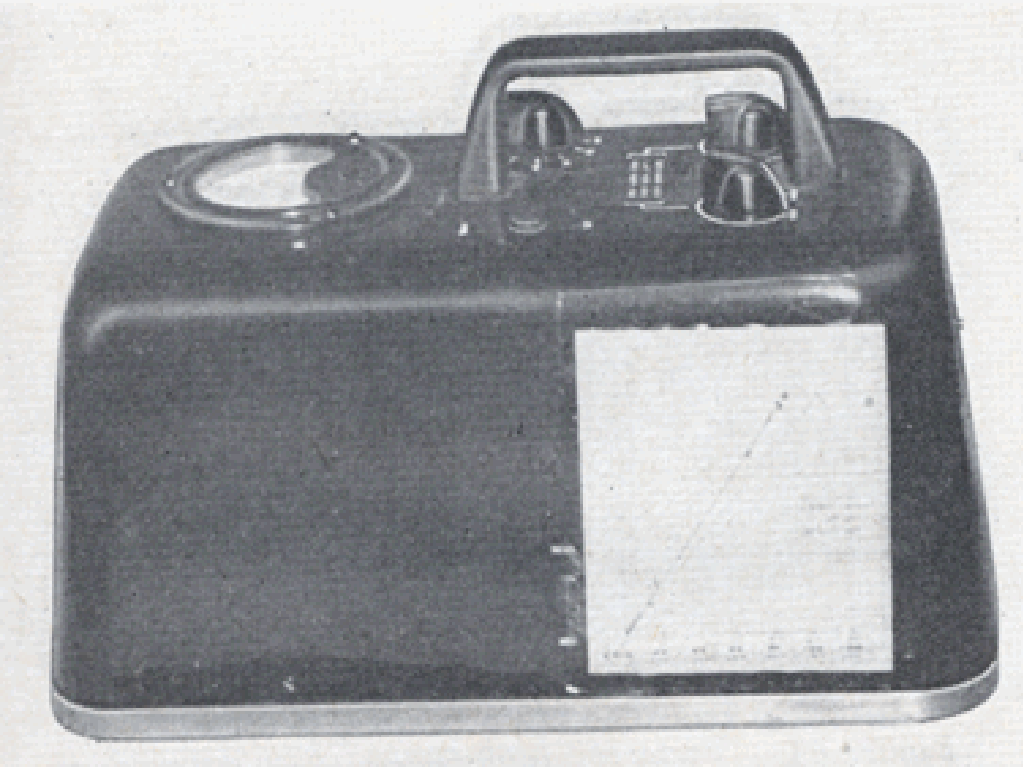
Rauland Manufacturing Company
The Rauland Manufacturing Company was located at 4245 North Knox Avenue in Chicago, Illinois in 1948. They produced the commercial version of the Zeus. They offered the Model Z-100 “Zeus” survey meter for alpha, beta and gamma or a Model Z-100A modified for gamma only.
The Model Z-100 was an ion chamber for alpha, beta and gamma monitoring in 1948 used at Operation Sandstone. It was determine that the instrument was designed for laboratory use and found to be not suitable for field survey work. The Model Z-100 was designed to measure alpha, beta and gamma ionization chamber with four ranges of 1, 4, 20 and 100 mR/h. Other units had ranges of 25, 100, 200, and 2,500 mR/h. It had a removable shield on the bottom to expose the internal chamber. It measured from 0-1,000 mR/h. The unit weighed 5 lbs.
Rauland Zeus Model Z-100 1948
Rauland Zeus Model Z-100 late 1940's
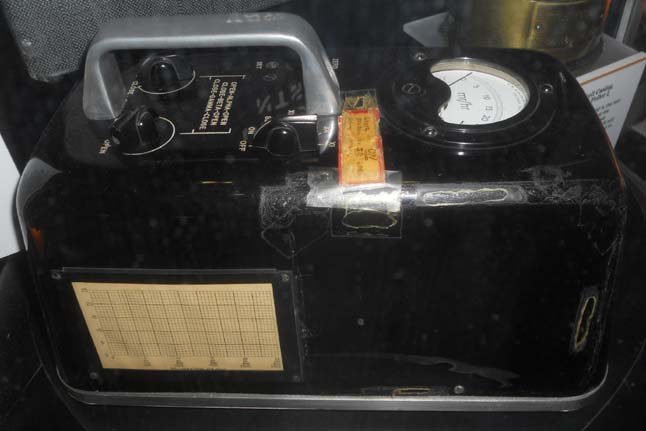
Rauland Zeus Model Z-100 late 1940's (from the National Atomic Testing Museum, Las Vegas, Nevada
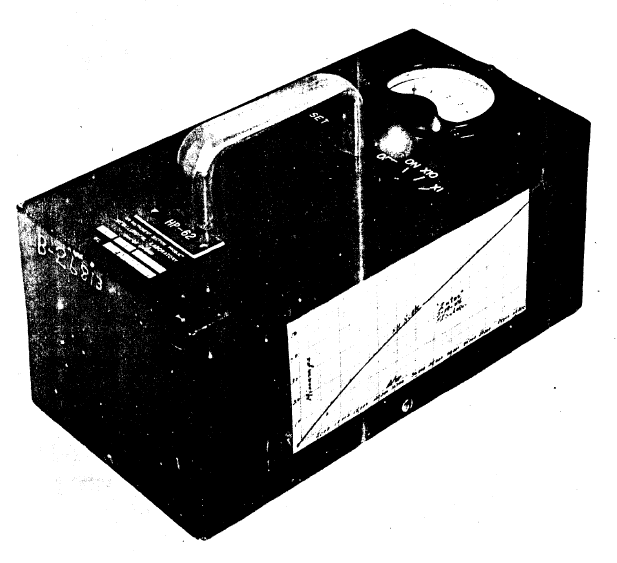
The Zeus is a medium-sized, portable survey instrument with an ionization chamber. One side of the chamber has a thin nylon diaphragm. The instrument has a plastic shield for the window for filtering betas and a thin aluminum screen for filtering out alphas. It has an on-off switch and two scale settings. The instrument measures gammas between 5 mR/h and 2 R/h.. It measures ionization current from betas and alphas. The unit had a meter that read in 0-25 microamperes and a conversion chart up to 55,000 cpm. It was calibrated with 27 mg radium, 700 mCi cobalt-60 and alpha sources.
A converted Model Z-100A was also developed to measure gamma radiation only. The range was from 1, 4, 20 and 100 mR/h. It contained a mylar covered chamber with a removable ½” thick lucite beta shield. The unit was 12.5” x 7” x 8” and weighed 10.3 lbs. It had a rigid painted metal surface. The Model Z-100A was for gamma only with four ranges from 25, 100, 500 and 2500 mR/h. The unit has no thin window for beta detection. The unit measured 13” x 10-3/8” x 5-3/8” and weighed 10.3 lbs. The case was smooth plastic with a rigid anodized metal handle. The chamber was 4.5” x 6” x 4”. The unit sold for $275 in 1948.
Need photo
Rauland Zeus Survey Meter Met Lab 1949
The 1952 Zeus was a medium sized instrument for utilizing an ionization chamber with a thin nylon diaphragm forming one side of the chamber. It has a plastic shield for beta discrimination and an aluminum shield for alpha discrimination. It could measure 2 mR/h and 2 R/h.
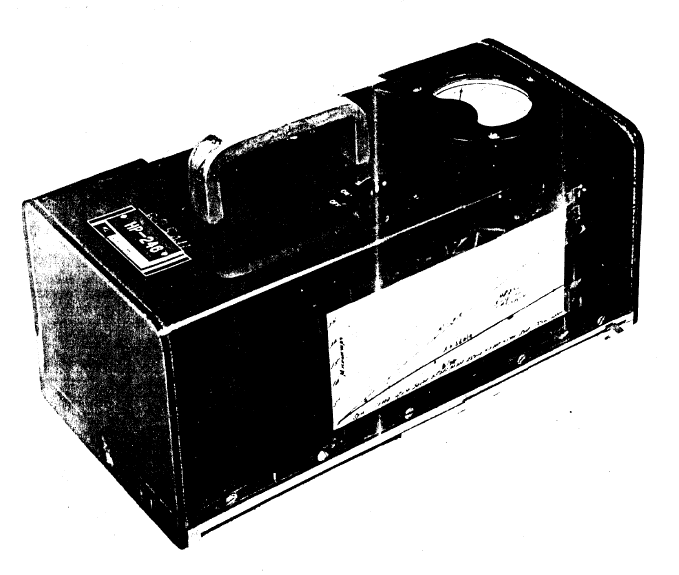
Zeus Meter 1952
The Modified Zeus was used at Oak Ridge prior to 1954. It was modified to measure airborne radioactivity and particularly gaseous compounds containing weak beta emitter such as H-3 and C-14. It detects alpha, beta and gamma. An open window to the ion chamber is covered by a copper screen. It is setup to alarm above a pre-selected setting. The unit is 6.5” x 6.5” x 17” and weighs 8 lbs.
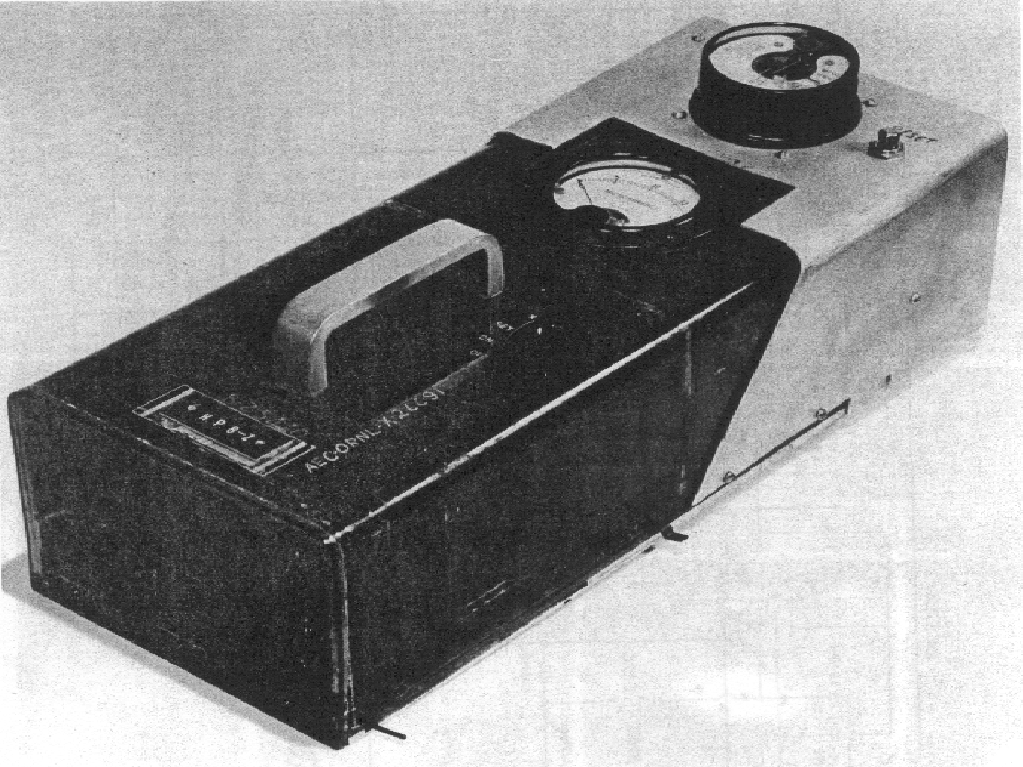
Modified Zeus for Air Contamination 1953
The Zeuto (Zuto) is an ion chamber instrument similar to the Zeus but calibrated for alpha only and developed in 1945 as an improvement over the Argonne Sandy. It was designated the Mark 1, Model 2. It was developed by Francis Shonka at the University of Chicago. It had a meter in microamperes and an on-off switch with X1 and X10 settings and could measure from to 50,000 dpm. The unit was 10.5” x 5.5” x 5.5” and weighed 3.5 lbs. The Super Zeuto (Mark 1, Model 10) was developed in 1945. It had a range of 5,000 to 50,000 dpm. The unit was manufactured commercially by Victoreen as the Model 356.
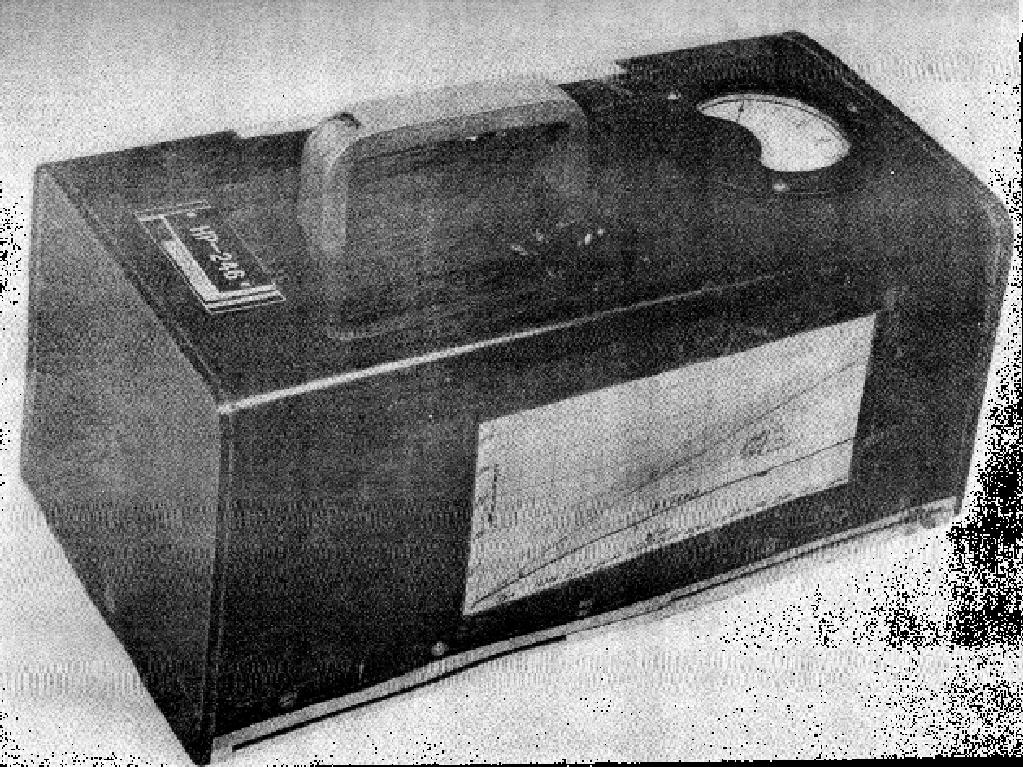
Zeuto 1946
The Zeuto Mark 1, Model 10 Type A was developed in 1946 for measuring alpha contamination on flat surfaces. It is battery operated. The ionization chamber has a window 100 sq cm and is covered with a metal screen and “a piece of stretched nylon” made electrically conducting. It has a x1 and x10 scales. It is housed in a metal box 10.5” x 5.5” x 5” and weighed 9 lbs.
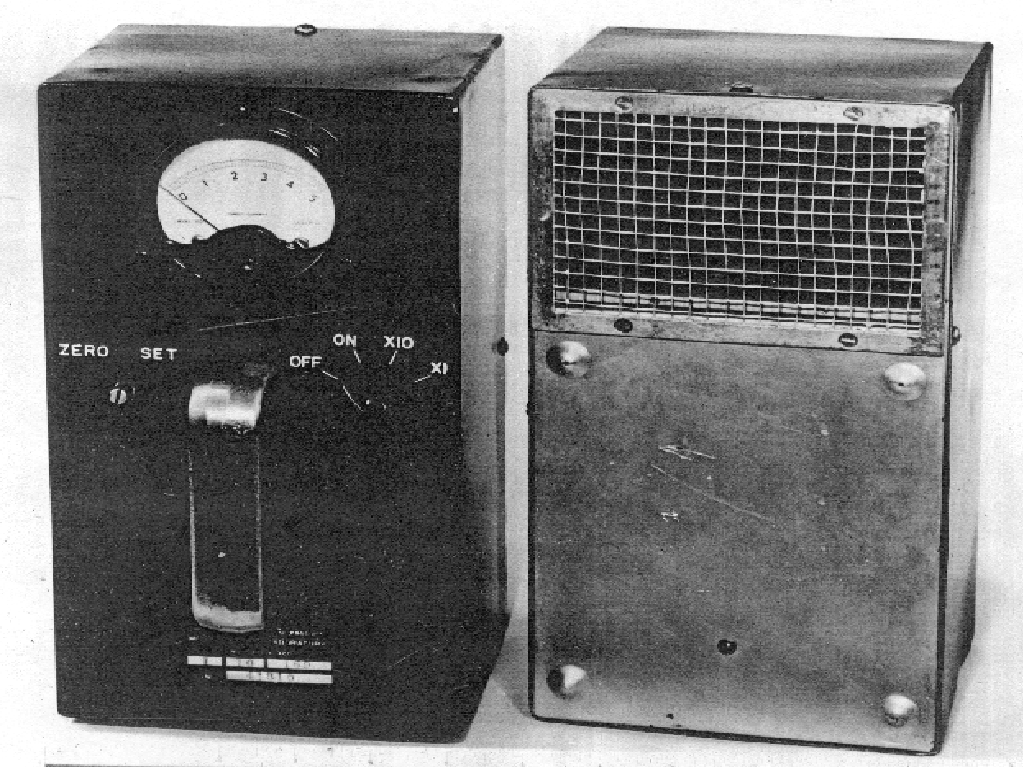
Zeuto Mark 1, Model 10 Type A 1946
Zeuto Mark 1, Model 10 Type A 1946
The Zeuto (Zuto) Alpha Survey Meter dates back to 1943 and developed by W.P. Jesse. It may be the second instrument designed for measuring alphas. It could measure from 6,000-60,000 dpm. The unit was 10.5” x 5.5” x 5.5” and weighed 9-5/8 lbs. The chamber was 1.75” x 3.5” x 5” with a tin window. It was offered as an alternative to the Poppy. It was manufactured commercially by Victoreen as the Model 356 in 1950's. The first alpha meter was thought to be the Pluto. The name Zeuto appears to be a combination of Zeus (another instrument developed by Shonka) and Pluto.
Zeuto Alpha Survey Meter 1952
In 1945, the Mark 1, Model 30 was a beta gamma survey meter with ranges of 1 or 20 mR/h. It was similar to the Hallicrafter Model 5 and weighed 15 lbs.
Several other instruments were developed and available in 1945. The Mark 1, Model 31 was a portable beta gamma meter with ranges of 0.5, 2.5 or 12.5 mR/h and weighed 15 lbs. The Mark 1, Model 31A was an improved version of the Model 31 which was similar to the Victoreen Model 263 and weighed 13.lbs. The Model 32 was similar to the Model 31A with register but not meter. It weighed 17 lbs. The Model 33 was a portable beta gamma with headphones and used a low voltage permanent gas GM tube. It weighed 2 lbs. The Model 40 was a portable alpha meter with air proportional counter probes. It weighed 17 lbs. The Model 41 was a modification of the Model 40 and had ranges of 1000 or 10,000 cpm and weighed 11 lbs. The Model 50 was a slow neutron portable survey meter with the same circuit as the Model 41. It had ranges of 1000 or 10,000 cpm and weighed 7 lbs. The Model 60 was the beta-gamma portable survey meter (the Landsverk and Wollen Electrometer). It had ranges of 100 and 1000 mR/h and weighed 5 lbs.
The “Sigmion” Mark 10, Model 70 was developed in 1946 as an integrating radiation meter for beta and gamma. It was developed by the Instrument Section at the Met Lab. It has a 50 cc ionization chamber that integrates the charge up to 20 mR/h and then sounds an alarm and resets. The total from each measurement is tallied on a register to obtain the total dose. The unit is self-contained and battery powered. A cap is provided for the ionization chamber to exclude betas. It had a uranium rod to balance grid current. The unit weighs 15 lbs.
Need photo
Sigmion Meter 1946